Bonjour, Wrong Side of the Road: Your First Motorhome Trip Across the Channel, Without the Nerves
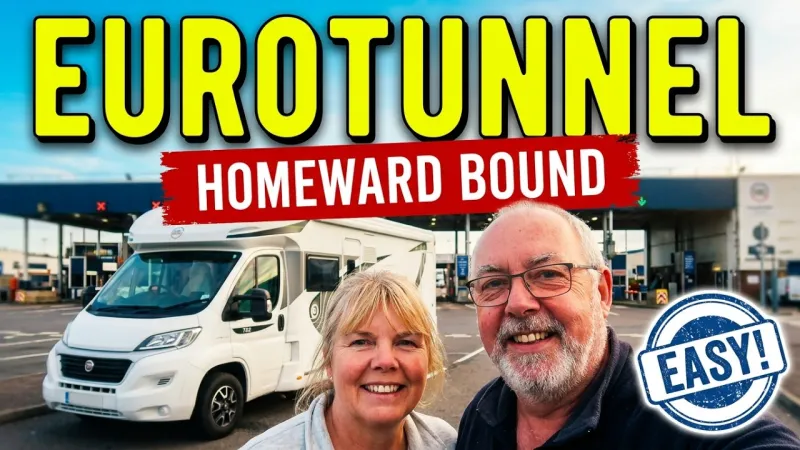
Photo: motorhome driving off Eurotunnel shuttle France, via i.ytimg.com
There's a moment, usually about half an hour after you've collected the van, when it hits you: in two days' time you'll be driving a seven-metre motorhome on the other side of the road, in a country where the road signs are in a different language and the fuel pumps are labelled in litres you'll have to convert. Deep breath. Thousands of British hirers do this every year, and the overwhelming majority come back wondering what all the fuss was about. Here's how to be one of them.
Folkestone or Dover? The Ferry Question, Sorted
If you're hiring from the southeast, the Eurotunnel Le Shuttle at Folkestone is the path of least resistance. You drive the van onto a train, sit still for 35 minutes, and roll off in France with the engine still warm. No sea, no swaying, no queuing for the loo in choppy waters. For a first-timer, that predictability is worth a lot.
The Dover ferry, on the other hand, is often cheaper — sometimes dramatically so, especially with a van-sized vehicle supplement factored in — and there's something properly holiday-ish about watching the White Cliffs shrink behind you over a bacon roll. Book whichever suits your budget and your stomach. Just note that most operators treat motorhomes as high-sided vehicles, so check the height and length restrictions when booking; some sailings and shuttle carriages have limits.
Whichever you choose, arrive early. Not ferry-early — check-in-early early. You'll need the hire paperwork, your passport, and time to spare. Ask your hire company in advance for a letter of authority to take the vehicle abroad; without it, you can be refused travel. This is not the moment to discover your hire agreement restricts you to the UK.
The Dart Charge (and Other Things to Sort Before You Go)
If you're hiring from further north and routing via the M25 and Dartford Crossing, register for the Dart Charge — it's free to cross northbound but must be paid by midnight the following day, and rental vehicles complicate things slightly. Either pay online after you've crossed using the van's registration, or set the account up in advance with your hire company's blessing. Five minutes of admin, zero fines in the post three months later.
Same energy applies to the French side: motorway péages are pay-as-you-go and easy (keep a handful of euros or a contactless card handy — though many lanes are now card-only, which is honestly simpler), while the Crit'Air emissions sticker is required for driving in several French cities including Paris, Lyon and Lille. If your route skirts urban centres, order the vignette online before you travel — it costs a few pounds and takes weeks to arrive by post, so don't leave it to the eve of departure.
Driving on the Right: Less Terrifying Than Advertised
Everyone dreads it; almost everyone adjusts within an hour. The trick is to load the dice in your favour:
- Leave the port and follow a vehicle. Matching the flow takes the decision-making out of your hands for the first few miles.
- Roundabouts go anticlockwise. Say it out loud as you approach. Nobody's watching.
- Priorité à droite still catches Brits out on minor country roads — traffic from the right can have priority even when you're on the bigger road. Slow down at junctions in rural France and let the rules surprise you gently.
- Stick a note on the dash reminding you which side the fuel cap is on. You'll thank yourself at the péage petrol station at 9pm.
Your hire van will likely be right-hand drive, which actually helps enormously — you sit on the kerbside, giving you a natural reference point for where the edge of the road is.
Aires vs Campsites: Where to Actually Sleep
France's aires are the stuff of motorhome legend: thousands of designated stopover points, many costing €10 or less, some free, ranging from a gravel car park behind a boulangerie to lakeside spots with electric hook-up. For a first trip, mix it up — a night or two on an aire for the freedom and the baguette-from-next-door experience, then a proper campsite for the long showers and the washing machine.
Apps and sites like Park4Night and CampingCard ACSI make planning simple, and unlike the UK, wild camping in a motorhome is broadly tolerated in much of rural France (with common-sense exceptions — no town centres, no National Parks, no leaving litter). That said, on a hire trip we'd suggest booking your first night's campsite in advance. Arriving off the shuttle at teatime with no plan and no French mobile data is how holidays get off to a wobbly start.
The Small Print That Matters More Abroad
Here's the bit nobody reads until they need it. Before you leave the UK, confirm:
- Insurance extends to Europe — and for how many days, and which countries. Some policies exclude certain Eastern European nations entirely.
- Breakdown cover includes the continent, and that you have the correct emergency number to call (it's usually not the UK number).
- The green card / vehicle documents situation — ask your hire company exactly what paperwork to carry.
- Excess and deposits abroad — a claim from France can work differently to one from Cumbria, so know who to ring and in what order.
Photograph everything — the van's condition, the documents, the insurance certificate — before you board. If the worst happens on the A26, you want the evidence in your pocket, not in an email chain at home.
The Soft Landing
Our honest advice for a first Channel crossing: keep it simple. Calais to somewhere lovely within two hours' drive — the Opal Coast, the marshes of the Somme, the orchards of Normandy — for the first couple of nights. Get your aires confidence up, get your roundabouts flowing the right way, buy the picnic you've been dreaming about since Dover, and only then decide whether you're pushing south.
The Continent isn't going anywhere. Neither is the van. And once you've done it once, you'll wonder why you spent years holidaying two hours down the M5 when a whole continent was a 35-minute train ride away.
Bon voyage — and remember, roundabouts go anticlockwise.